



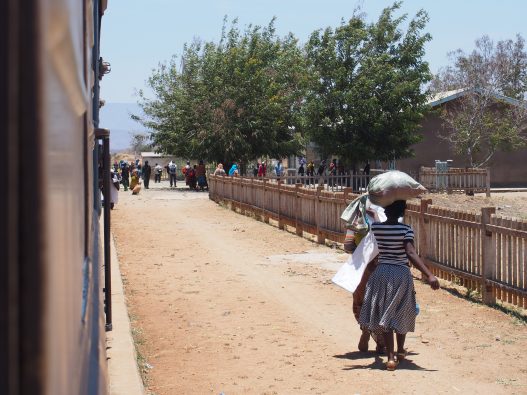
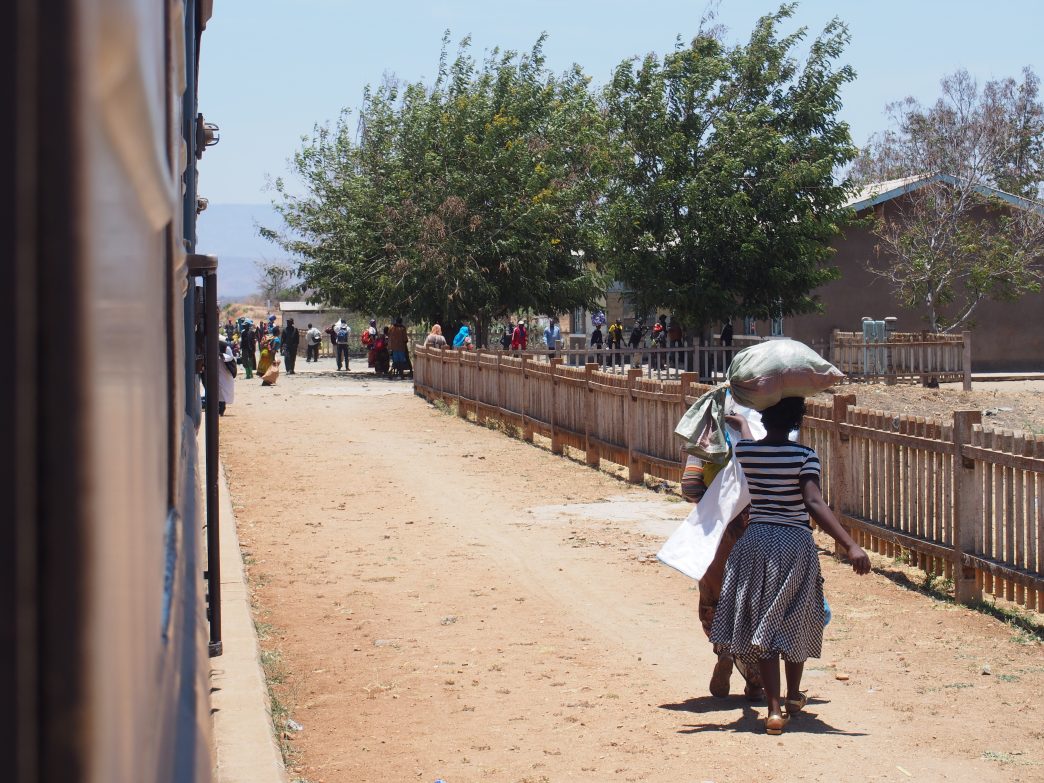
The sun is rising over Zambia’s Central Province. Here in Serenje, time seems to pass slowly, punctuated by birdsong and the sound of trucks passing by on the main road. Though another noise, deeper and more serious, disturbs the morning calm. It is the distant rumble of a diesel engine, amplified by the dry air, announcing the imminent arrival of an iron giant. Serenje, a modest district capital, is preparing for the passage of the TAZARA train.
Perched on the Tanzania-Zambia railway line, Serenje is neither a bustling capital nor a mining town. It is a strategic crossroads, an essential stop for the train that connects Kapiri Mposhi, in the heart of Zambia, to the Indian Ocean at Dar es Salaam. For the locals, the train is not just a means of transportation; it is an umbilical cord, a breath of fresh air from the outside world, and for many, the only affordable option for survival.
The station: a heart that beats slowly but still beats
Serenje station is a building that has not lost its old-fashioned charm. Built in the 1970s, it features functional architecture typical of the era, with its beige walls covered in worn lime and brown woodwork peeling in the sun. On the platform, Mr. Jonathan, the stationmaster, checks his watch for the tenth time in an hour. It’s a habit.
“The train was supposed to arrive at 6 a.m., but with TAZARA, you learn patience,” he tells me with a tired but sincere smile. He has been here for over twenty years. He has seen thousands of faces come and go, tons of goods, and has witnessed the slow erosion of what was once a flagship of South-South cooperation. “The passenger service often encounters technical problems. People were desperate. Now the Mukuba Express is back, but it only runs once a week in each direction, instead of twice.”
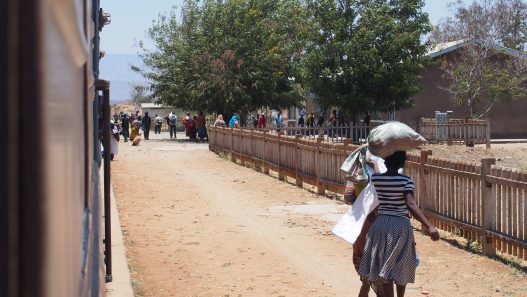
Under the covered platform, the atmosphere is both feverish and resigned. About twenty passengers wait, crowded around mountains of bales and yellow cans. The train, announced two hours late, is awaited like the Messiah.
The choice of reason: between savings and safety
In the shade of a mango tree I meet Grace Mwila, a woman in her fifties with rough hands. She is sitting on a blue plastic crate filled with cabbages and tomatoes. She is on her way to her sister’s house in Mbeya, Tanzania, to sell her harvest.
“The bus? Oh no, it’s too expensive and too dangerous,” she says, shaking her head. “My one-way ticket in third class to the border costs me a little over $20. The bus would be at least double that, and those drivers drive like maniacs. At night, there are a lot of accidents on these roads. On the train, I can sleep. It’s slow, yes, very slow, but you arrive alive.”
Her words echo those of many passengers. The slowness of the train has become synonymous with safety. For small traders like Grace, the price difference is also a matter of economic survival. Every kwacha saved on transportation is a kwacha that can be reinvested or sent to family.
A few meters away, a group of younger men load bags of corn into the luggage van. One of them, Chilufya, a tall, lively-eyed man, explains that he is a regular in this cross-border trade: “I transport corn from Serenje to Nakonde, on the border. There, Tanzanian brokers come to buy it. Sometimes I continue on to Tunduma. The train allows me to transport 50-kilogram bags that I could never have put on a bus. It’s my livelihood.”
He is the embodiment of the informal but vital trade that thrives along the railway line. TAZARA is not just a link between two countries, it is an artery that feeds the local economy, allowing Zambian agricultural products to reach Tanzanian markets and, conversely, manufactured goods and dried fish to make the reverse journey. Like Catalina Mutale, who transports 50 kilos of bananas on the line every week, these traders have learned to cope with discomfort and delays. “You get used to it,” she tells me philosophically as she adjusts her six baskets.
An uncertain future, but hope remains
Taking advantage of the wait, I return to see Mr. Jonathan in his office. An old fan hums painfully, trying to cool the dusty air. On the wall, a portrait of President Hakainde Hichilema hangs next to an outdated TAZARA calendar. I ask him about the future of this historic infrastructure. He sighs deeply before answering. “The future? It hangs by a thread, but also by a huge hope. This line was built in 1976 by the Chinese. It was a gift, a project of freedom to open up Zambia from Southern Rhodesia (now Zimbabwe) and apartheid South Africa. For decades, it transported our copper to the ocean. But the lack of maintenance, the dilapidated equipment… that’s our biggest challenge. Our locomotives date back to the 1970s. The rails are worn out, the sleepers are rotting.”
Construction of the railway began in 1970 and the line opened to traffic six years later. The work mobilized 50,000 Chinese and 60,000 African workers, at least 65 of whom died from malaria and an unknown number from work-related accidents.
The challenge of maintenance: a brake on ambition
The literature on TAZARA is unanimous: the number one problem is maintenance. Mr. Jonathan had told me earlier: “With locomotives out of service, we can’t transport enough freight, so we earn less money, and we can’t repair the locomotives.”
Some passengers I met in Serenje told me about journeys that lasted 72 hours instead of 46. “When you get on this train, you leave your watch at home,” one of them joked fatalistically.
TAZARA, born of a pan-African political ideal, is becoming an essential link in China’s new Silk Road. It is a reflection of Africa: a giant with a glorious past, facing immense challenges, but driven by incredible resilience and vitality. The train that connects two countries is much more than just infrastructure. It is a social, economic, and human link. For Grace, Chilufya, and all those waiting on the platforms, it is the only link to a better future.