





In San, a scourge is spreading invisibly but affects almost the entire population. It manifests in people’s minds. The decline in the quality of information is an an open secret.
At a time when Mali is facing a combination of security, social, and economic crises, staying informed has become a vital need, almost as essential as the three daily meals.
With the advent of social media, information has become an open field. Rural populations are increasingly connected to the internet. Distinguishing truth from falsehood, right from wrong, has become a real challenge for consumers, and sometimes even for media professionals, who find themselves caught between a rock and a hard place. Today, we operate in a national context where the information landscape is highly polarized, mainly by publications related to the security crisis, diplomatic tensions, and issues of sovereignty.
However, nowadays in Santoro and Karentela, understanding what is happening, for example getting information about fuel realities, knowing the black market price to buy it at the lowest cost, finding out which gas station is open or whether the queue is too long, or understanding the security situation in surrounding villages, has become a survival reflex. Information is not a luxury, but a tool for security.
Local media: precarity and the weakening of information
During the 4th edition of the Mali Media Forum, held on August 1, 2025 at the Bamako International Conference Center (CICB), an initiative of the Association Salon des Médias du Mali and CREACOM AFRIQUE, the aim was to highlight the contemporary challenges of information while promoting culture, in line with the declaration of the President of the Transition making 2025 the Year of Culture. On that occasion, the president of the Maison de la Presse, organizer of the event, stated: “If it were not for the massive withdrawal of partners, a community radio station used to carry out up to 70% of its activities thanks to funding from a single NGO in its locality.”
The massive departure of certain partners, the saturation of the radio market, and the emergence of new local media outlets have plunged community radio stations into unprecedented precarity. “With Donald Trump’s decision regarding USAID, several of our partners terminated our contracts. Even AMAPROS-SNV wrote to inform us that they could no longer continue with us for financial reasons,” explained the promoter of a local radio station in San (06/23/2025).
Journalists and hosts frequently work without stable salaries, without sufficient technical resources, and with few opportunities for continuing education. This fragility directly affects the quality of the information produced and broadcast. “In San, no radio station can employ someone as a salaried worker with the revenue it generates. No host can live solely from hosting programs. The information sector in Mali is at a total impasse: neither organization nor professionalism,” said a program director of an influential radio station in San (06/23/2025).
Yet community radio stations remain the primary sources of information, especially for rural communities. The city of San has around ten radio stations. Some hosts, with more than twenty years of experience, have become true public figures and strongly influence local opinion.
However, these stations operate in a pressured environment. Dependence on advertising weakens their editorial independence. As the saying goes: the hand that gives is the hand that commands. Despite the ban by the High Authority for Communication (HAC), some stations continue to broadcast advertisements not authorized by law, for lack of economic alternatives. This economic shortfall has pushed several young hosts to retrain as videographers or DJs for ceremonial events.
In this context of uncertainty, verification of local information increasingly relies on informal networks: correspondents in villages, improvised phone calls to acquaintances, voice messages shared on social media. Under such conditions, adhering to the fundamental principles of journalism becomes a real challenge.
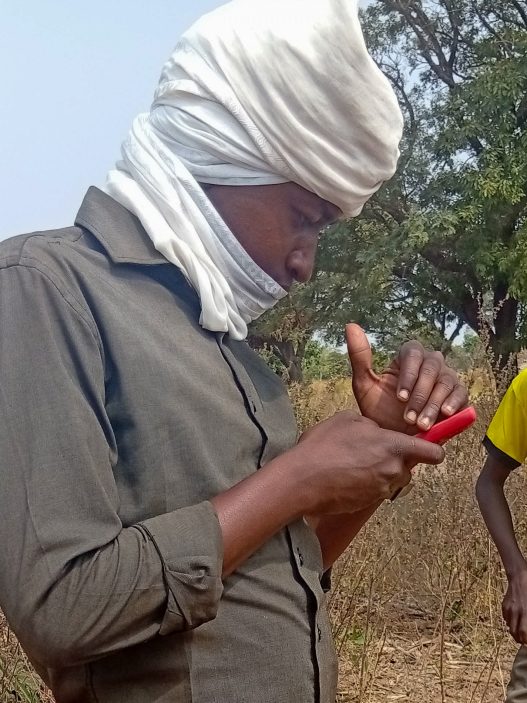
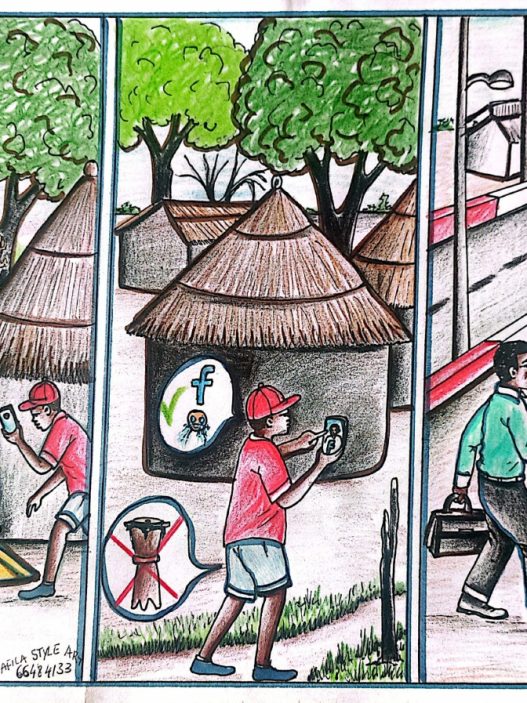
Thus, the multiplication of local radio stations that do not always practice professional journalism, and social media, combined with the anxiety of the security context, accelerates the circulation of unverified information. In San, where mobile connectivity is now widely accessible, even elderly people consume videos and voice messages daily, informing themselves about the country’s situation through TikTok and WhatsApp.
For the average citizen, it remains difficult to determine whether something qualifies as journalistic reporting. A journalist is supposed to distinguish verified facts from biased messages. But citizens often receive everything without filters. For example, an elderly Bwa man, sitting in front of his house with his tea, listens to the radio to understand what is happening in the world and in his country. Yet he does not always have the necessary reference points to differentiate real information from rumors circulating here and there.
Energy crisis and information overload
The energy crisis has affected all key sectors of the city of San. It has also caused overload in the production and broadcasting of information at certain radio programming hours: “When we have a program scheduled around 1 p.m. and there is a power cut at noon, the program is postponed. This adds to other already disrupted programs, which becomes a real headache,” explained a radio promoter (06/23/2025).
Another effect of the energy crisis is the amplification of misinformation. One episode clearly illustrates this: at the beginning of the crisis, a business operator sold diesel from a 45,000-liter tanker to the San power plant. A commercial act that was quickly interpreted by some people as a free donation intended to relieve the city.
The rumor spread so quickly that some local media professionals repeated it without verification. It took the intervention of the Governor of San, who called upon the oil company’s communications officer, to publicly restore the truth.
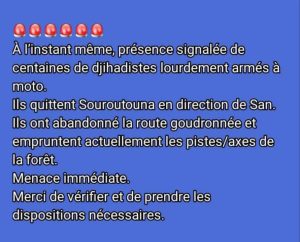
A more recent case: Monday, January 19, market day in the city of San. A screenshot circulated in several WhatsApp groups, warning of the alleged presence of armed groups heading toward San. This information caused panic at the market and disrupted the atmosphere; some traders did not take the time to verify what followed. No credible rapid verification mechanism was available, and this silence allowed collective anxiety to persist.
These examples, among many others, are not isolated. Rumors about security, internally displaced persons, or administrative authorities, including the governor himself, circulate constantly. The “grins” (informal tea circles) have become real discussion forums, where local and national news is debated. Everyone shares what they have seen or heard on social media.
Truth becomes blurred, unstable, sometimes anxiety-inducing, and the population is directly affected by this situation, even though it also participates in the spread of false information.
What responses to disinformation?
In times of crisis, when emotions run high and are easily manipulated, information becomes a double-edged sword. It can create a climate of collective fear and disorder, but it can also ease tensions and contribute to peacebuilding.
To combat misinformation and hate speech, the organization Search for Common Ground, which has been working in San for more than four years, has strengthened the capacities of radio hosts in fact-checking techniques. It broadcasts awareness-raising audio spots on certain radio stations and has set up groups of young “cyber-guardians” to ensure that rumors do not create psychosis. But given the reality on the ground, these actions remain modest and sometimes limited.
There is therefore an urgent need for professional and legal training for media actors and young people with large followings on social media. “I did not receive prior training in using social media as an influencer. I just like it and integrate myself into this field by gathering information from people. So if I could benefit from training as well as equipment, I could do much more,” said an influencer from San (06/28/2025).
In the face of growing polarization and recurring rumors, establishing a local information verification unit who brings together administrative authorities, media, and civil society, appears to be a credible path forward. Other possible actions include: organizing awareness discussions within tea circles; training young leaders, content creators, and associations in fact-checking techniques and in writing non-polarizing discourse; strengthening the skills of online media professionals and supporting them economically; and multiplying awareness campaigns with them on the dangers of misinformation and hate speech. These local media outlets are close to the population and rooted in daily realities. Supporting them means empowering them to inform without dividing, to raise awareness without fueling tensions, and to promote dialogue within communities.
From San to the whole of Mali, accurate, verified, and responsible information can contribute to peacebuilding. Today, more than ever, peace is also built through thoughtful words, calming discourse, and by cleaning up our digital environment.