

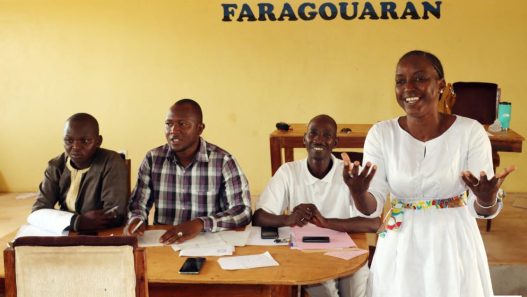

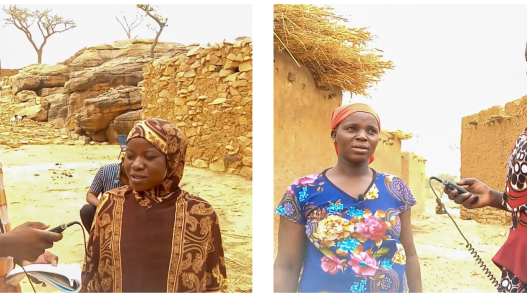
In the city, we’re told that the village is dangerous, full of witches who poison people and are jealous of our success. In the village, they say the city is arrogant, full of magicians with dirty money who look down on us. For over 20 years, I believed these lies. In November 2024, I decided to see for myself. I left the city for the first time in my life. I discovered another side to it: a village at the heart of other villages, situated in the department of Fianga.
In this village, the air is fresh, the trees are lush and the river flows nearby. In this river, there are hippos and plenty of fish that provide for the whole department. At the entrance to this village, there are flowers with melancholic scents, whose raised nectaries seem to welcome all who set foot on its soil.
In the morning, one finds a soothing calm, accompanied by the dew. But in the evening, everything comes to life: children dance around the fire, stories are told, and folk dances are organised to the beat of the tam-tams – a real opportunity for young people to find their ‘soul mate’.
I am Christian, a young city-dweller born in N’Djamena. I am the sort of person we usually refer to back home as: ‘Born in N’Djamena, raised in N’Djamena’, as if to say that I know nothing of the village or its traditions.
For over 20 years, I had never set foot in the village. Among my circle of friends – made up of city folk, and even some members of my own family – the village isn’t held in high regard. In fact, I was constantly told: ‘Over there, there are sorcerers, people who are against the future of city folk. Don’t go near them under any circumstances, or you’ll risk losing your life.’ ”
As for the relatives who came from the village, they would tell us: “City folk are rude and arrogant. Their money comes from dirty dealings and witchcraft. They only come to the village for bereavements or funerals. ’ Hearing this over and over again, I felt ashamed. Ashamed of my name, ashamed of not speaking the language of my homeland, ashamed of not knowing my homeland.
In my mind, there was a wall. A cousin with a car became a ‘magician’; a village asking for help became ‘poor’. It was this shame that drove me to leave, to set off and discover this forbidden world. Perhaps I’ll lose my life there, as my family told me I might? Are the people in the village poor, as others have told me? I have to go there to find out.
The Door I forced open despite my aunt’s fears
My aunt, a city dweller who had learnt of my curiosity to explore the village, did not approve of the idea. ‘Do you want to go and get eaten out there?’ She was afraid. She told me the village was dangerous: ‘Especially as the end of the year approaches. That’s when many take the opportunity to practise witchcraft, to renew their rituals.’
”
My aunt began to tell me she’d had a nightmare in which, if I went to the village, the witches would kill me. I was stunned by her words, but my mind was made up: I would set off to find out for myself, despite her tears.
In Kéra culture, when an aunt, an uncle or a relative makes a prophecy about you, it is believed that it will eventually come true. Such is the power bestowed upon them—by whom and in the name of what, I do not know. Their dreams have a profound impact on the lives of their loved ones.
That night, weighed down by my aunt’s nightmare, I couldn’t sleep a wink. The questions kept going round and round in my head: what if she was right? What if I lost my life out there?
At that moment, I realised that the beliefs I associated with the village also existed all around me, even in the city. My aunt lives in the city, but she believed that her dream might foreshadow what was going to happen to me. I’d thought these beliefs were unique to the village. But in the end, perhaps the difference between the city and the village wasn’t as great as I’d thought. Beliefs simply take different forms.
But there was something else too: an impatience, a burning curiosity, a longing to go and discover my home and my people. ‘Let me see for myself. If I have to die, I’ll die in Kera,’ I insisted. She finally let me go, albeit reluctantly.
When I arrived, covered in dust, the children, my uncles, the land chief, the village chief and other villagers were all gathered under the tree. I was given a mat and some cool water, drawn from a large canary pot covered in fern, leaning against a mango tree in the large courtyard. “You are the son of the house,” said an old man wearing a tattered shirt that revealed his almost bare chest.
Every evening, two or three young people would come and sit beside me, not to ask for money, but to ask questions. That evening, feeling a bit tired, I decided to take my mind off things by scrolling through Facebook. Sitting in a locally made armchair, some young cousins had gathered round me, their eyes glued to my phone screen. Out of curiosity, one of them asked: ‘How do you get into university? Is it true that the internet’s really fast?’ In their eyes, you could sense a desire to learn, to discover new things. Little by little, the wall I’d built in my mind – or rather, my preconceptions about village life – began to crumble.
The hand that shattered more than 20 years of fear
That evening, as night fell, we gathered in the moonlight. That moment, so simple, held a special significance for me. Gathered with my family, chatting away at the top of our voices, without a care in the world. It was on that day that I understood the full meaning of the saying:
‘Happiness lies in the little things.’
White steam rose from the tray my aunt was holding. A large ball of dough, placed loosely in the tray already containing okra sauce, was set down on the ground, in the middle of the circle formed by my uncle, a few cousins and me.
No chairs, no spoons, just our hands, which we’d washed in the same basin. ‘A hungry stomach has no ears’ – we tucked into the meal in remarkable silence. The only sounds were those of jaws savouring the food and fingers kneading the ball of dough. Like a choir that had rehearsed the night before for a performance, every movement was in unison, right down to the gestures of our fingers. As for me, I was ashamed that I wasn’t doing as the others did. I was afraid they might judge me because I came from an urban background: ‘There’s the city lad who doesn’t even know how to eat.’ ”
My cousin managed to interrupt the imaginings and thoughts racing through my mind. With a single gesture, he wiped his hand on his shirt and looked me straight in the eye. In front of everyone, he said: “You’re not what they told us you were. You’re sitting on the floor with us, you’re dipping your hand into the same dish as us, you’re laughing with us – you’re one of us.’ Thirty seconds after my cousin spoke, a complete silence fell. Then, all of a sudden, everyone burst out laughing.
In a single sentence, 20 years of fear crumbled to the ground like dust. That evening, I realised: the problem isn’t the village. The problem is that we never eat from the same dish.
When the drum spoke louder than my fear
The sun was beating down hard that day; it was as if it had come out with all its children. As I set out that morning, I rubbed ointment on my feet to combat the dry skin, but the dust got the better of me – it stuck to my feet.
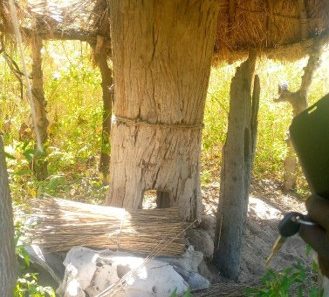
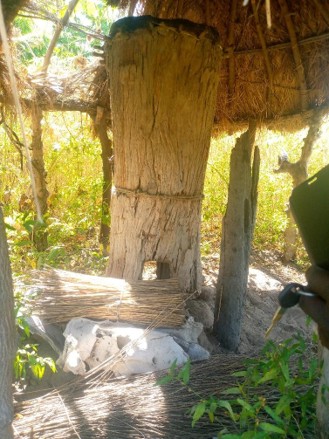
As I entered the village, I saw that talking drum. Standing tall, immense, over two metres high – a hollowed-out tree trunk, tied with ropes, placed beneath a thatched hut. At its feet lay bundles of straw. Upon seeing this sacred drum, my anxiety grew and my blood ran cold. I automatically recalled my aunt’s warning when I’d insisted on coming to the village. ‘There are sorcerers over there; they perform rituals. Don’t look, don’t touch.’ As I remembered my aunt’s words, my hands began to tremble and my heart was pounding. I said to myself: ‘Christian, you’ve come here to die.’
After that incident with the drum, I didn’t say a word to anyone, but I didn’t sleep a wink all night; in my head, that drum was speaking, calling out to the spirits. The next day at dawn, I got up before everyone else. Fear was stronger than shame.
‘Uncle, come with me to the village chief,’ I whispered.
‘Why?’
“I want to see that drum up close.”
We arrived. The silence was so heavy; there was only the sound of dry grass crunching under our feet as we stepped on it. Five or six young people from the village were sitting in the shade of a tamarind tree, chatting quietly as if to say, “We mustn’t make any noise; the drum is resting.”
I moved closer to where they were. With a trembling voice, I decided to break the silence to get a better understanding of the situation. “Er… Uncle… what’s that for?” The uncle looked at me; he saw the fear in my eyes. And he burst out laughing. A hearty laugh, without any malice.
‘You’re scared, aren’t you, city boy?’ I lowered my head
‘Yes,’ I said
He stood up and placed his hand on the rough wood of the titir.
‘See that? It’s not for killing, it’s not for casting spells. That’s the titir. The herald drum. On the day a village leader dies, we beat it here. Boom. Boom. And the sound carries across the fields, across the rivers. All the surrounding villages hear it. They know: a prominent figure has passed away. It’s our radio, my son. Before the telephone, before the radio, this was it.
Silence fell after his words. And in that silence, I lowered my eyes. I, who grew up with qualifications, the internet, N’Djamena… …I was afraid of a patch of woodland. I, who thought I knew everything, knew nothing. Today, when I look at that photo of the titir again, I’m no longer afraid. I hear my uncle’s voice: ‘That’s our radio.’ And I wonder how many other things we used to look at from a distance for fear of asking.
In the shade of the mango tree, sharing a meal on the ground, amidst bursts of laughter and dancing in the moonlight, I realised that the city has qualifications, networks and money. The village has the land, the culture, the memory and the labour. If we remain separated, we’ll fall. If we come together, we’ll build. We must speak the truth; we must see one another; we must eat together.
I am writing for those lads from the city who are afraid. The day the city is no longer afraid, the day the village is no longer ashamed to ask, the day we say to one another: ‘I need you’ – on that day, we will truly begin to build.