

Over the Academy Mali’s five years of activities, a wide range of themes and issues have been explored, from school dropout and joking relationships in Timbuktu to displacement in central Mali, gender (in)equality, the role of the griot in peacebuilding processes, and cultural traditions such as N’domo.
Below, we highlight a selection of these topics.
Social Cohesion
A number of themes have been explored and developed by one or more branches of the Academy.
The theme of social cohesion proved particularly important to the young people participating in the programme. It was approached from two different perspectives: social relationships within communities, and the relationship between tradition and cultural history on the one hand, and modernity on the other.
Social relationships within communities
Social relationships within Malian communities, both at the local and broader level, have come under increasing strain as a result of the multiple crises affecting Mali and the wider Sahel region.
The current crisis in Mali began in the north in 2012, fuelled by armed independence movements. Although northern Mali experienced a period of relative calm following the signing of the 2015 peace agreement, central Mali, particularly the regions of Mopti and Ségou, has continued to experience violence involving terrorist armed groups and community-based militias. There are concerns that the threat could spread further south. The conflict has also spilled over into neighbouring Burkina Faso and Niger, and towards the coastal states of Benin, Togo, and Ghana, as well as the Lake Chad region, including Chad, Cameroon, and Nigeria.
The forces driving radicalisation remain strong, and some young people in Mali have also become vulnerable to radicalisation. Combined with discrimination and stigmatization, radicalisation can contribute to outbreaks of interethnic violence, potentially escalating into conflicts both between and within communities.
At the same time, the crisis cannot be explained in simple terms. It is highly complex, involving multiple causes, actors, and consequences. Alongside radicalisation, which cannot simply be attributed to religion, factors such as poverty, inequality, limited state presence, insecurity, unemployment, and a lack of opportunities and prospects for young people also play a role. The young people involved in V4T Académie Mali live within this context. They are acutely aware of the conflicts around them and, in some cases, are directly or indirectly affected by them.
At the smaller scale of Voice4Thought Académie, however, art and creative expression have emerged as spaces where differences can be bridged while maintaining a critical perspective on the realities people face. How do different groups relate to one another? How do individuals with different backgrounds and perspectives interact? And where can they find a sense of connection and shared identity?
One example of a production that illustrates how young people at the Academy have explored these questions is a dialogue in a theatre piece about the community of Wouro Weltaré.
“On vit à côté, mais on ne vit plus ensemble”
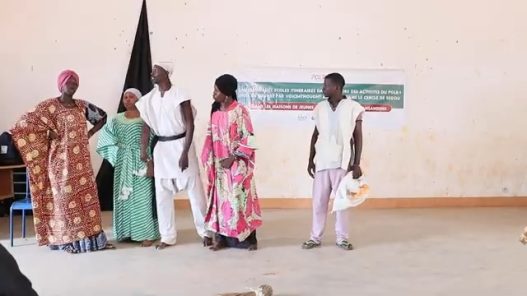
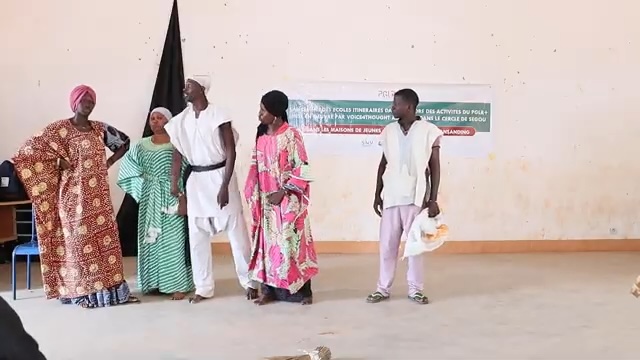
In the village of Wouro Weltaré (a fictional name), in the Douentza region, a theatre piece was created about a community that has become deeply divided following the arrival of armed jihadist groups. Where residents once belonged to the same community, divisions emerge when some young people join these groups and others become victims of the violence that follows. Families are torn apart, people disappear or are killed, and feelings of mistrust, guilt, revenge, and grief create lasting divisions.
When some of the young people eventually return, the community is faced with the question of how to respond to them. Can they be welcomed back? Can forgiveness be offered without forgetting the suffering of those who were harmed? And how can the community learn to live together again?
In front of one of the young men’s shops, which also serves as a grin—an informal gathering place where people meet to drink tea, talk, exchange ideas and concerns, and discuss social issues—a group of young men begin talking. Two women who come to buy tea and sugar join the conversation. One young man observes: “On vit à côté, mais on ne vit plus ensemble” (“We live side by side, but we no longer live together”), and suggests starting a dialogue among members of the community in an attempt to restore peace. Rather than resorting to violence, one of the other participants suggests, words and stories can help bring people back together.
The play brings together themes of radicalisation, violence, memory, justice, forgiveness, and reconciliation. It shows how jihadist violence not only creates direct victims, but can also profoundly and long-term disrupt social relationships within a community.
Tradition and modernity
“Each of us has one foot in the past and our head in the 21st century. No one starts from scratch – and we would gain nothing by pretending otherwise.”
— Fatoumata Keïta, in an interview about her novel Sous fer, 2015
Young people in Mali are searching for their place in society, as well as for a sense of identity and social belonging. As part of this broader search, they are also exploring the relationship between tradition and modernity. Young people in Mali find themselves at the intersection of traditional social structures and a changing, modern society. Combined with the multiple crises described above, this has created a situation in which the culture of their parents no longer fully reflects their own.
What is their relationship with their parents’ generation? How do traditional values and practices relate to modernity? How do young people perceive this relationship? What matters to them? And how do they give expression to these values and ideas?
As they search for their own identity, they also explore where they come from and how their traditions live on through them.
The mask tradition in Markala
Every year, the town of Markala in the Ségou region hosts festivals celebrating masks and puppets, an old tradition shared by several communities, including the Bambara, Bozo, Marka, and Somono. During the dry season, these communities come together for ceremonies featuring masked dances, drumming, singing, and mask and puppet performances.
The Ségou branch conducted research into the socio-economic significance of Markala’s traditional mask and puppet festivals. Based on a quantitative survey of local residents, the research examined the contribution of this cultural tradition to society and the local economy. The findings showed that the festivals are not only an important cultural tradition, but also provide a valuable space for social interaction, contributing to social cohesion, cultural preservation, and dialogue, while creating temporary economic opportunities for local entrepreneurs.
Read the research report here.
These findings are reflected in a theatre piece about the mask festival, which centers on the question: How does this tradition relate to modern times, particularly in relation to traditional gender roles? The play brings together young people, the presidents of the young men’s and women’s associations, and a married couple.
The wife of the head of the household says:
“We women are fed up with this whole mask and puppet tradition. Whenever the festival comes around, our children and our husbands are no longer ours. They spend all day making masks. And on top of that, we women are the ones who cook, fetch water, and look after the guests and visitors. We’ve had enough. It’s a tradition that has no value at all.”
The young people see things differently. They believe that preserving and continuing the tradition is important. The president of the youth association says:
“It is the only tradition our ancestors have left us.”
The president of the women’s association agrees:
“The mask and puppet festival is an occasion for people to come together again. We have to welcome many people from outside the region.”
She reminds the wife of the head of the household:
“Kadia, if you remember, it was during one of these festivals that Bouaré saw you. And thank God, you are now married to him.”
Read a synopsis of the theatre piece here.
Young people see value in preserving traditions and cultural forms of expression, as well as in the knowledge they carry. They regard the festival as a form of heritage passed down by their ancestors and therefore something worth preserving. At the same time, the theatre piece shows that young people also question the traditions, roles, and practices associated with them, for example, the expectation that women should bear responsibility for the household, and seek to continue and reshape these traditions in their own way. The woman’s remark, “We’ve had enough,” opens up the conversation around these questions.
The young people do not simply inherit these traditions; they actively sustain them while also interpreting them in ways that reflect their own needs and values. For them, Sogo Bô is not only about performing an old ritual, but also about bringing people together, strengthening unity, and contributing to the development of the community. The young people organize the festival, bring the masks into public spaces, and create opportunities for people from different places to reconnect. The festival also introduces younger generations to the history and traditions of their village.
In this way, young people connect traditional values with contemporary social and economic interests. In the play, tradition and modernity are therefore not necessarily presented as opposites. Instead, young people use tradition as a way of bringing their communities together in the present while looking towards the future. By reconnecting with traditions and reinterpreting them in the context of the present, they also find ways to strengthen connections among themselves and between the different communities involved—the Bozo, Bambara, Marka, and Somono.
Read the slam text here.
The slam piece about the mask festival builds on the research and theatre production, highlighting the young people’s belief that respecting tradition and the older generation is essential to preserving the continuity of their community.
A conversation with Oumar Colibaly, who is responsible for bringing out the masks, featured in the video about the Ségou mobile school training, also shows how much older generations value young people’s interest in the tradition. Together, different generations give meaning to and shape the tradition.