


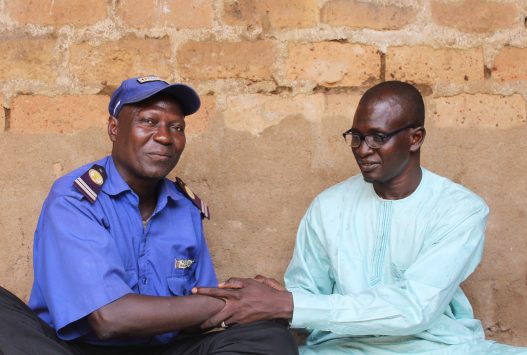
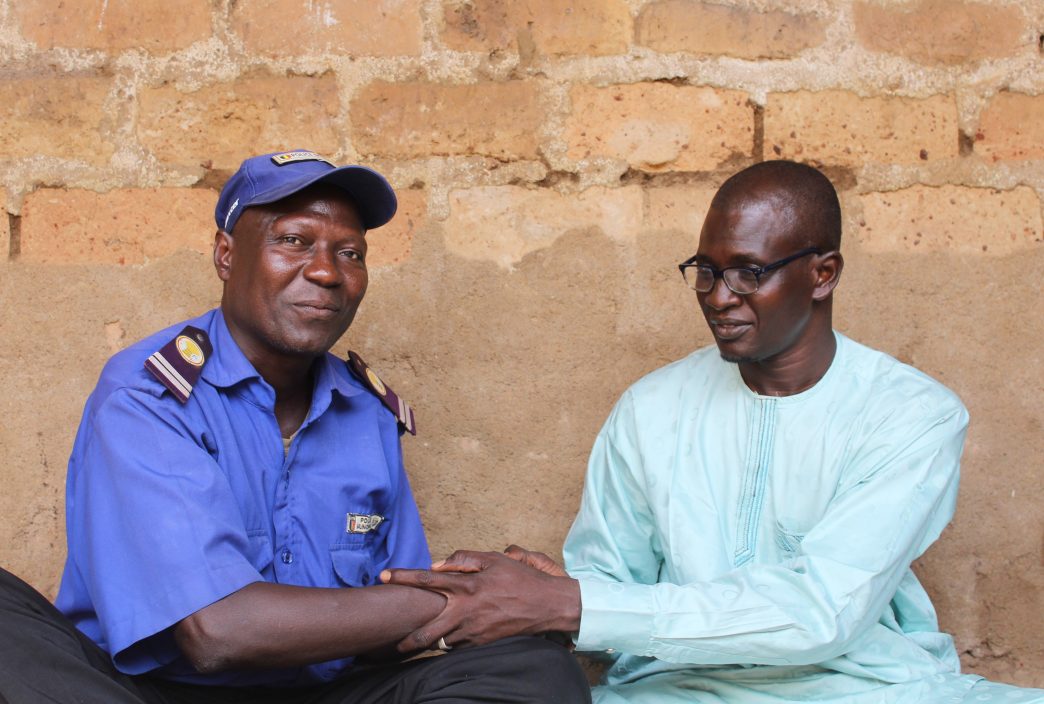
Abakar Mahadjir, a Muslim and father, settles in Guelkoura 2 in Moundou, a neighborhood in Chad’s capital N’djamena, with a strong Christian identity. Seven years later, a court case is still making its way through the courts, a mosque has sprung up between two bars, and his neighbour, Guelmbaye Kodé Joël, sits beside him every morning as if nothing had happened.
Neighborhoods that carry an identity before a name
It is 7 a.m. in the Guelkoura 2 neighbourhood, in Moundou’s 3rd district. On the road leading down from the asphalt of Ngarta Tombalbaye Avenue to the Adventist Church, the bars have already opened their doors. Young people, calabashes in hand, tease one another in the noisy bustle left over from a night of dancing. A few metres away, a compound opens onto the street, squeezed between two drinking establishments. When we knock twice on the half-open gate, a voice from inside answers: “fadal” (come in, in Arabic).
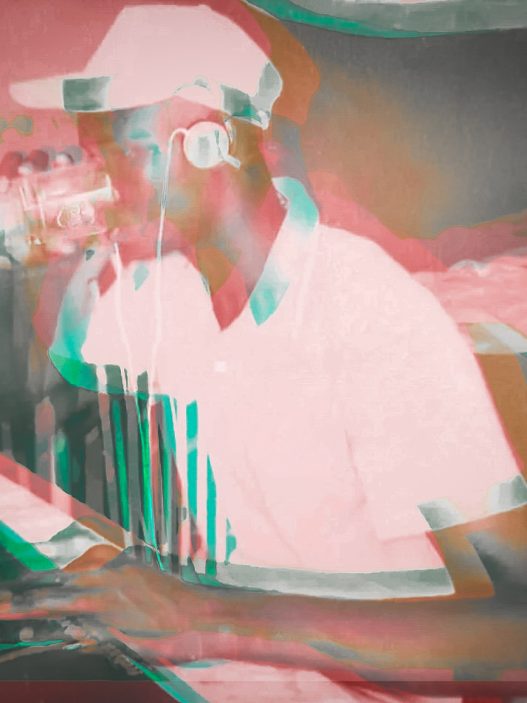
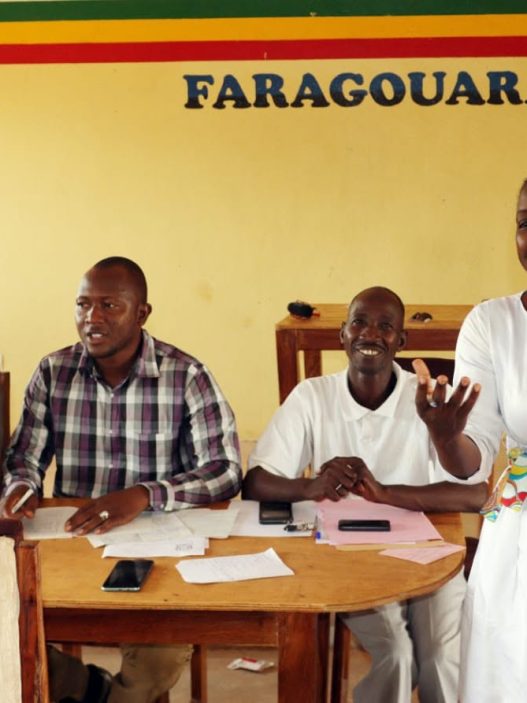
Inside the cramped courtyard, the sounds of the street fade away. Under a corrugated iron shelter, we meet Abakar Mahadjir, a slender man in his forties, dressed in a sky-blue djellaba. With a broad gesture, he spreads out a woven mat. After a long exchange of greetings, he puts on his glasses, as if to signal that the conversation can begin. His neighbour, Guelmbaye Kodé Joël, whose house stands directly opposite, joins us and casually sits down beside him. A Municipal Police officer, he wears a blue shirt and black trousers bearing the stripes of a lieutenant. A large thermos of tea arrives, brought by Abakar’s wife, followed by the youngest child of the household, a little girl of about two years old who watches us with quiet suspicion. She leaves again immediately, her face half covered.
In Moundou, Chad’s economic capital and a cultural crossroads, people tell the same story. “The Bornou, Haoussa and Baguirmi neighbourhoods are inhabited mainly by Muslim families, including traders. By contrast, the neighbourhoods of Guelbé, Guelkoura, 15 Ans, Lac-Taba and others – sadly known for their ever-growing number of bars and drinking establishments – have a strong Christian identity,” Abakar explains. It is in this part of the city that he decided to make his home.
“This neighbourhood particularly interests me”
The story goes back to 2019. Abakar has lived in Moundou for more than twenty years and has lived in many neighbourhoods across the city. It is through a friend that he discovers Guelkoura 2. “This neighbourhood particularly interests me. I had no idea what it represented.” After briefly interrupting himself to ask his daughter to go back to her mother at the other end of the compound, he continues. “I have lived in many neighbourhoods in Moundou,” says Abakar. “But here, there is space. There is peace inside the compound. And then, I don’t know how to explain it, I like the mix. The people are good.”
On the day he moved in, looks came before words. Neighbours stood on their doorsteps. Eyes followed the coming and going of the furniture. No one came to help.
The curiosity, however, did not fade. It hardened. The first weeks revealed something Abakar had not quite expected. “Here, there are people who are constantly getting drunk, too many bandits, and too many drinking establishments with nightlife. Sometimes the smoke from the plastic burned during the distillation of Argui (a local drink obtained through distillation) even drifts into our homes.”
A plot of land bought, tongues begin to wag
The pressure does not come only from the neighbourhood. Among his fellow believers, the way his situation is viewed is hardly more sympathetic. Some come to visit him not out of solidarity, but out of morbid curiosity: to see with their own eyes the conditions in which “one of their own” lives in this territory. “When some friends and brothers came to visit me, they commented on every little thing: the exchanged looks, the bars. They may have been right about the facts. But their way of looking at things did not help me.”
Seven years of silent coexistence. Then an ordinary act – the purchase of a plot of land directly opposite the house he rents – changes everything. Abakar notices the plot up for sale. He gets in touch with the owner, negotiates, and concludes the sale. After completing the administrative formalities, the occupants are given a deadline to vacate the premises. Among them is one of the neighbourhood’s busiest bars. After the deadline, the security forces intervene. The occupants leave. That is when the rumours begin to circulate. A silent disapproval settles around him. “Some people approached the seller to ask him to cancel the sale. For them, he should not have sold this plot of land to a foreigner, a Doum, a Muslim.” He gives a slight smile.
The opponents of the sale organise their response. They offer the seller twice the purchase price to persuade him to back out. The seller hesitates. Abakar learns of the manoeuvre. “I declined the offer to reimburse me for the purchase price and the expenses I had already incurred. I legally own this land. The matter has been in the hands of the judicial authorities for two years.”
Two years. The construction site has come to a standstill. Although the plot has been fenced off and some construction has begun, every morning Abakar crosses the empty space opposite his home. “I do not understand: why should a Muslim not be allowed to buy land in this neighbourhood? They even called my neighbour Joël and his family accomplices.”
Joël, who has been listening in silence, speaks with measured calm.
“I have lived in this neighbourhood since 1993. At first, there were no Muslim families. Little by little, today some compounds are inhabited. Here, people use terms like Doum, and others. This distinction is not good. Once, a road accident involving a Muslim and a young Christian nearly escalated here in the neighbourhood.” He goes on to explain that this kind of tension recurs in the neighbourhood. But, in his role as a municipal officer, he quickly intervenes with the neighbourhood chief to calm tempers.
Abakar interrupts him: “I do not understand what Doum means, but it is not pleasant. There are also some Muslims who call Christians Karcha. As far as I know, it comes from the word “Christian”. But in the end, all these names are not good. I do not use them.”
What is the secret of their peaceful coexistence? Why does it work between these two men, between these two families? Abakar lifts a corner of the veil: “We are like brothers. Every day, each of us asks about the other. That really impresses me.” Joël adds: “Even on days when there is a ceremony on one side or the other, the two families always end up together.”
An ally where no one expected one
It is in this context – an ongoing court case, mistrust firmly established – that something unexpected has developed between the two households.
Abakar says: “I have never known a Christian family as remarkable as Joël’s. They have supported us greatly throughout this situation. Sometimes, when I have a family ceremony, it is under the spacious shelter of their house that I receive my relatives. They take part freely in our moments of sharing.”
Joël does not comment. He nods, lifting his glass of tea to his lips. For him, things are simple: his neighbour is his neighbour. “We know each other. We know how each of us lives. That changes things.”
A mosque in the neighbourhood – and it changes something
Seven years after Abakar’s arrival, his family is no longer the only one. Gradually, other Muslim families have settled in Guelkoura 2, opening businesses in different parts of the neighbourhood. A space of about ten square metres now serves as a mosque. “Thank God, today we have a mosque in this neighbourhood. We go to the mosque on Fridays and they go to church on Sundays. That is how we live.”
“Walahi!” adds his neighbour Joël, who has understood that coexistence is not fusion. Each keeps his own practices, his own spaces, and his own rhythm. What has changed is the ordinariness of the other’s presence. The very first mosque in this Christian neighbourhood is no longer an event. It has become part of the landscape.
The anomaly is in fact the norm everyone desires
Together for more than a year, Abakar and Guelmbaye have no apparent conflict to report. But what is striking is the way those around them react. Their neighbours, on both sides, continue to ask them about their “way of living together,” as though it required an explanation, as though it were an anomaly. What is experienced as exceptional, a Muslim and a Christian who appreciate one another, help each other, and share a shelter on the day of a celebration, is in fact what the great majority of Moundou’s inhabitants wish for their city.
The court case over Abakar’s purchase of the plot of land is still ongoing. The bars are still noisy at night. But a mosque has taken root, families continue to arrive, and in Abakar’s courtyard, the tea is served hot, while Joël casually sits down beside his neighbour. It is little. It is also, perhaps, where everything begins.